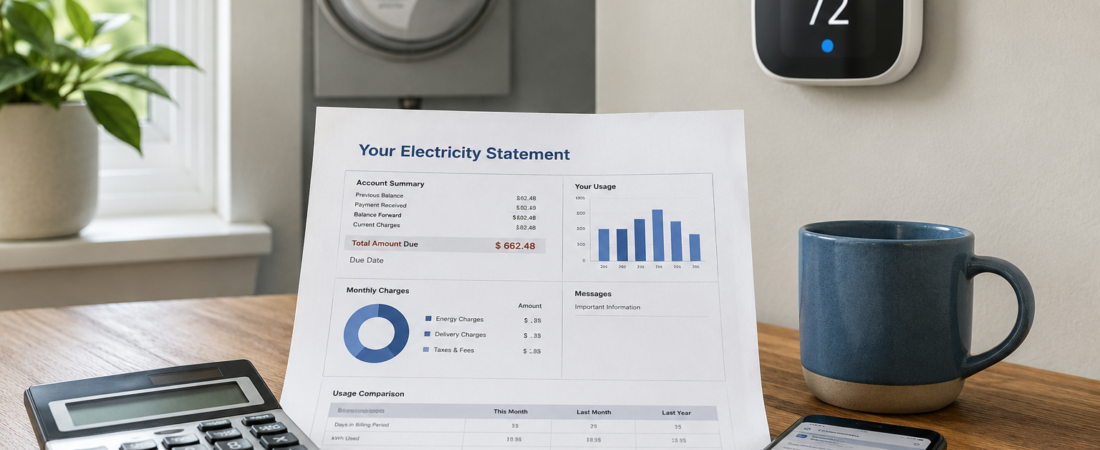
Quick answer: A $500 electric bill is high for most U.S. households, but it can be plausible during extreme heat or cold, in a large all-electric home, or when electricity rates are unusually expensive. The important question is not only the dollar amount. Compare the billing days, total kilowatt-hours (kWh), price per kWh, fixed charges, weather, and your normal seasonal usage.
For context, the U.S. Energy Information Administration reported a national residential electricity price of 18.34 cents per kWh in June 2026. At that rate, a $500 energy charge would represent roughly 2,726 kWh before taxes and fixed fees—more than three times the 2024 national average monthly household use of 865 kWh. That makes a $500 bill a warning to investigate, not automatic proof that the utility made a mistake.
When Can a $500 Electric Bill Be Normal?
A bill near $500 can occur without an error when several cost drivers happen together. A large home may use central air conditioning for long hours during a heat wave. An electrically heated home can consume large amounts of power during a cold spell. A pool pump, electric vehicle, hot tub, well pump, dehumidifier, space heaters, or electric water heater can also add substantial usage.
| Possible situation | Why the bill can reach $500 | What to check |
|---|---|---|
| Extreme summer heat | Air conditioning runs longer and harder | Daily kWh, thermostat settings, filter, equipment condition |
| Electric winter heating | Resistance heat and auxiliary heat use large amounts of power | Heat-pump backup heat, weather, insulation, thermostat |
| High-rate location | Each kWh costs much more than the national average | Supply, delivery, time-of-use and tiered rates |
| Long billing cycle | More days are included than usual | Service dates and average daily usage |
| New electrical load | EV charging, pool equipment or a new appliance adds consumption | Usage before and after the change |
How Much Electricity Does $500 Represent?
Use this formula to separate price from usage:
Estimated kWh = energy portion of bill ÷ price per kWh
| Electricity rate | Approximate kWh represented by $500 |
|---|---|
| 12¢ per kWh | 4,167 kWh |
| 18.34¢ per kWh | 2,726 kWh |
| 25¢ per kWh | 2,000 kWh |
| 35¢ per kWh | 1,429 kWh |
These examples treat the full $500 as an energy charge. Real bills may include customer charges, delivery fees, taxes, fuel adjustments, arrears, deposits, or late fees, so use the actual energy charge and actual rate printed on your statement.
Seven Checks to Make Before Calling the Utility
- Confirm the billing period. A 35-day bill should not be compared directly with a 28-day bill.
- Compare kWh, not only dollars. If kWh stayed similar but the total rose, the rate or added charges may be responsible.
- Compare the same season. Last month may have had very different weather. Compare with the same month last year when possible.
- Look for estimated readings. An earlier estimated bill may be corrected when the meter is read.
- Review new loads. Include EV charging, guests, pool equipment, portable heaters, dehumidifiers, and home projects.
- Check rate-plan timing. Time-of-use plans can make peak-hour consumption expensive.
- Separate current charges from old balances. A $500 amount due may include a previous unpaid balance rather than $500 of new electricity.
Warning Signs That Deserve Faster Investigation
Contact the utility when the meter number does not match, the usage is dramatically higher with no reasonable explanation, the bill covers the wrong dates, or a rate plan appears different from the one you selected. If the utility confirms the reading, consider whether malfunctioning HVAC equipment, a failing water heater, damaged ductwork, poor insulation, or an appliance problem is causing excessive use.
Do not open electrical panels or attempt hazardous electrical diagnostics yourself. If you notice burning smells, hot outlets, repeated breaker trips, sparks, or damaged wiring, stop using the affected equipment and contact a qualified electrician.
How to Lower a Very High Electric Bill
- Use the utility’s hourly or daily usage portal to identify when the spike occurs.
- Replace dirty HVAC filters according to the equipment manufacturer’s instructions.
- Seal obvious air leaks and use window coverings during extreme weather.
- Avoid relying on electric resistance space heaters for large areas.
- Shift eligible laundry, dishwashing, and EV charging to off-peak hours.
- Ask whether the utility offers a home energy audit, budget billing, payment plan, or income-qualified assistance.
- Compare your current rate plan with alternatives using a full year of usage.
For broader benchmarks, see our 2026 average electric bill guide. If cooling appears to be the main cause, our air-conditioner electricity cost guide shows how watts, operating hours, and local rates affect the total.
Frequently Asked Questions
Is a $500 electric bill normal for an apartment?
Usually not. It may be possible in a large apartment with electric heat, very high rates, a long billing cycle, or an old balance, but it deserves a careful review of kWh, dates, and charges.
Can air conditioning cause a $500 bill?
Yes. Long runtimes during extreme heat, a large home, poor insulation, duct leakage, dirty filters, or failing equipment can combine with high rates to produce a very large bill.
Should I dispute a $500 electric bill?
First compare the meter number, reading, billing dates, kWh, rate and prior balance. If something does not match, contact the utility and request an explanation or meter-reading review.
Bottom Line
A $500 electric bill is substantially above the national norm for most households. It can be legitimate, but it should be explained by high kWh use, high rates, unusual weather, a long billing cycle, added equipment, or non-energy charges. Compare average daily kWh and the same season last year before deciding whether the problem is price, usage, equipment, or billing.
Official Sources
- U.S. Energy Information Administration — Electricity Monthly Update
- U.S. Energy Information Administration — Residential Electricity Prices
- U.S. Energy Information Administration — Residential Bills and Consumption
- U.S. Department of Energy — Home Energy Upgrades
Educational note: This article provides general budgeting and troubleshooting information. Utility rates, billing rules, assistance programs, taxes, and household energy use vary. Confirm account-specific information with your utility or a qualified professional.