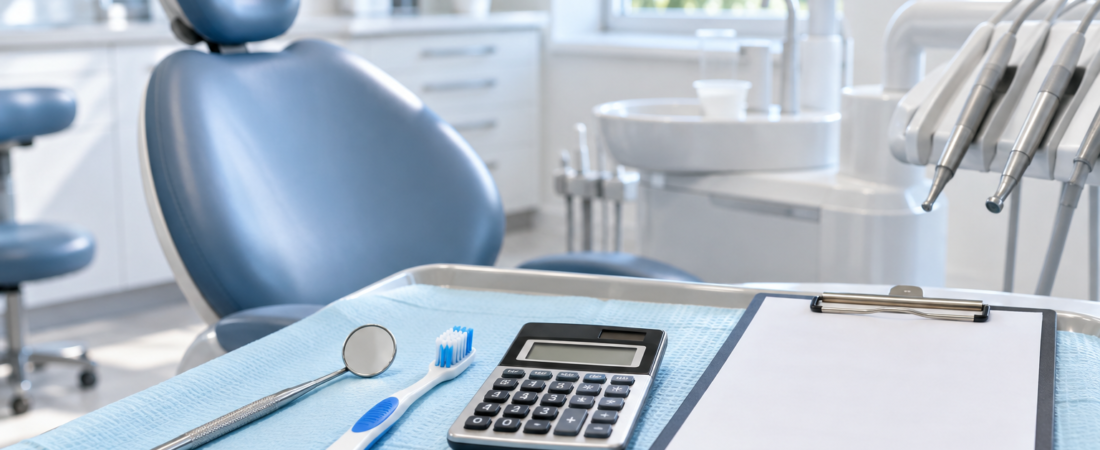
Quick answer: A routine dental cleaning without insurance commonly costs about $90 to $200 in 2026. A new-patient visit may total $150 to $350 when the exam and X-rays are billed separately. Deep cleaning for gum disease is a different procedure and can cost several hundred dollars per quadrant.
The amount you pay depends on your location, whether you are a new or returning patient, the type of X-rays ordered, and whether the dentist finds signs of gum disease. The safest way to compare prices is to ask for a written estimate that separates the cleaning, exam, and imaging charges.
Typical Dental Cleaning Costs Without Insurance
| Service | Typical self-pay range |
|---|---|
| Routine adult cleaning | $90–$200 |
| Dental exam | $50–$150 |
| Bitewing X-rays | $30–$100 |
| Full-mouth X-rays | $100–$250 |
| New-patient visit with cleaning, exam, and basic X-rays | $150–$350 |
| Deep cleaning | $150–$350 per quadrant |
These are budgeting ranges, not a national fee schedule. Dental offices set their own prices, and a lower advertised cleaning price may exclude the exam or X-rays.
Routine Cleaning vs. Deep Cleaning
A routine cleaning removes plaque and tartar above and slightly below the gumline for a patient without active periodontal disease. A deep cleaning—often called scaling and root planing—treats gum disease below the gumline. It may require local anesthetic, more time, and more than one appointment.
If the office recommends deep cleaning, ask which teeth or quadrants need treatment, why a routine cleaning is not appropriate, and whether follow-up periodontal maintenance will be required. The American Dental Association explains that periodontal procedures use different treatment and billing codes from a standard preventive cleaning.
Why the First Visit Often Costs More
A first visit commonly includes a comprehensive exam and diagnostic images. Returning patients may need only a periodic exam and limited X-rays. That is why two offices advertising the same cleaning price can produce different total bills.
- Location: rent, wages, and local operating costs affect fees.
- Patient status: new-patient exams are often more extensive.
- X-rays: frequency and type depend on oral health and clinical need.
- Gum condition: periodontal treatment costs more than routine cleaning.
- Additional services: fluoride, sealants, or oral-cancer screening may be separate charges.
Worked Budget Example
Suppose an office quotes $125 for a cleaning, $80 for an exam, and $60 for bitewing X-rays. The visit total is:
$125 + $80 + $60 = $265
If you return six months later and do not need new X-rays, the next visit might be only the cleaning and periodic exam. Ask the office which items are required and how long the quote remains valid.
How to Compare Dental Prices
- Ask for the cash or self-pay price.
- Confirm whether the quote includes the exam and X-rays.
- Ask whether the advertised price applies only to patients without gum disease.
- Request the procedure codes and a written treatment estimate.
- Compare at least two nearby offices using the same list of services.
HealthCare.gov notes that adult dental coverage is not an essential health benefit under Marketplace rules, and stand-alone dental plans may have waiting periods. Compare the annual premium, deductible, maximum benefit, network, and waiting period with the cash price before enrolling only to cover cleanings.
Ways to Lower the Cost
- Ask about new-patient packages and cash-payment discounts.
- Check dental schools or accredited dental-hygiene programs, where supervised care may cost less.
- Look for federally qualified health centers or local nonprofit clinics with sliding-fee programs.
- Use an HSA or FSA when the expense qualifies under your plan.
- Keep preventive appointments so small problems are more likely to be found before they require complex treatment.
Questions to Ask Before the Appointment
- What is the total self-pay price for cleaning, exam, and necessary X-rays?
- Will I be charged a cancellation or missed-appointment fee?
- If you recommend deep cleaning, can I receive the diagnosis and procedure codes in writing?
- Do you offer a membership plan, and what services are excluded?
- When is payment due?
Frequently Asked Questions
Is $150 reasonable for a dental cleaning without insurance?
Yes. A $150 cleaning can be within a normal self-pay range, especially in a higher-cost area. Confirm whether the price includes the exam and X-rays.
Why did my cleaning quote become much higher?
The office may have added an exam, imaging, fluoride, or periodontal treatment. Ask for an itemized estimate before treatment.
Does dental insurance make cleanings free?
Some plans cover preventive cleanings with little or no cost sharing, but frequency limits, networks, waiting periods, and annual maximums vary. Check the plan documents.
How often should I get a cleaning?
The appropriate interval depends on your oral health and your dentist’s clinical recommendation. A fixed six-month schedule is common, but some patients need different intervals.
Bottom Line
For budgeting, plan on roughly $90 to $200 for a routine cleaning alone and $150 to $350 for a new-patient visit that includes an exam and basic X-rays. Get an itemized estimate and make sure you are comparing the same services.
Official Sources
- HealthCare.gov: Dental coverage in the Marketplace
- HealthCare.gov: Dental coverage definition
- American Dental Association: Oral health topics
Last reviewed September 2026. Prices are general U.S. budgeting estimates, not a diagnosis, treatment recommendation, or quote from a dental provider.