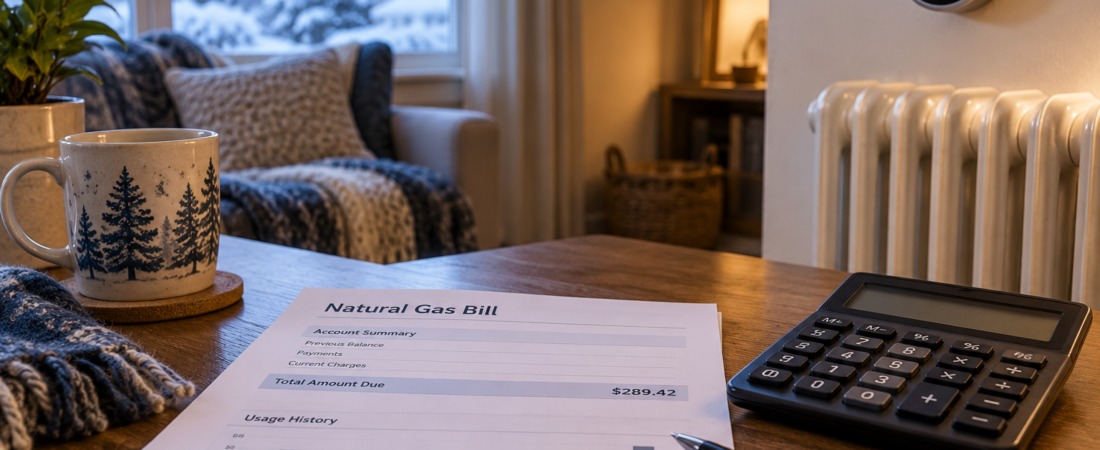
Quick answer: A $250 natural gas bill is high for many households, but it can be normal during a cold winter month in a larger, older, or poorly insulated home. The amount may also reflect high usage, local delivery charges, a longer billing period, or a past-due balance. Compare therms used—not just dollars—with the same month last year before assuming there is a problem.
How High Is a $250 Natural Gas Bill?
The same dollar bill can mean very different things because residential gas prices and household usage vary widely by state and season. The U.S. Energy Information Administration reported an average U.S. residential price of $13.96 per thousand cubic feet in January 2026 and $24.09 in June 2026. Summer prices per unit can look higher because fixed delivery costs are spread over much lower usage.
That is why a bill should not be evaluated by the national price alone. A northern household using natural gas for space heating may consume several times more gas in January than in July, while a household using gas only for cooking and water heating may have a much flatter pattern.
| Situation | How $250 may look |
|---|---|
| Small apartment, mild weather | Usually high |
| Average home during a mild month | Likely high |
| Larger home during a cold winter month | Possible |
| Older or poorly insulated home | More plausible |
| Bill includes past-due charges or deposit | Not a true one-month usage comparison |
| Sudden increase with similar weather | Worth investigating |
Start With the Usage, Not the Total
Look for the number of therms or thousand cubic feet used and the number of days in the billing period. Then compare both figures with the previous month and the same month one year earlier. If the utility provides weather information, compare heating degree days as well.
- Therms used: This is the clearest measure of household consumption.
- Billing days: A 35-day bill should be higher than a 28-day bill even at the same daily usage.
- Rate per therm: The commodity rate may change monthly.
- Delivery charges: Utilities may charge separately for moving gas through the system.
- Fixed customer charge: This remains even when usage is low.
- Adjustments: Taxes, deposits, late fees, budget-plan reconciliation, or past balances can raise the amount due.
Why Winter Gas Bills Rise
Space heating is usually the largest natural gas use in a gas-heated home. Colder outdoor temperatures increase the difference between indoor and outdoor air, causing the heating system to run longer. Wind, air leaks, low insulation levels, an aging furnace, and a higher thermostat setting can add to that demand.
Holiday guests, more hot-water use, gas fireplaces, and longer hours at home can also raise winter consumption. A single unusually cold billing cycle can therefore produce a bill that looks extreme compared with an annual monthly average.
Example Bill Breakdown
Suppose a household uses 150 therms during a cold month. At a combined usage-related cost of $1.40 per therm, that portion is $210. Adding a $15 customer charge, $12 in taxes and local fees, and $13 in other adjustments produces a $250 bill. In this example, the main cause is usage—not necessarily an unusually high gas price.
For another home, a $250 amount due might include only $160 of current gas service plus a previous balance. Always separate current charges from the total amount due.
When a $250 Bill May Signal a Problem
- Usage is much higher than the same month last year even after accounting for colder weather.
- The bill shows an estimated meter reading followed by a large catch-up adjustment.
- A furnace runs almost continuously or rooms remain cold.
- The water heater, fireplace, or another gas appliance is operating more than expected.
- The meter number or service address on the bill is incorrect.
- You smell gas or hear hissing near a gas line or appliance.
If you smell gas, leave the area and contact the gas utility or emergency services from a safe location. Do not attempt to locate or repair a suspected gas leak yourself.
Ways to Lower the Bill Safely
- Lower the thermostat a few degrees when sleeping or away, if safe for everyone in the home.
- Use a programmable or smart thermostat to avoid heating an empty home.
- Seal obvious drafts around windows, doors, attic access points, and plumbing penetrations.
- Replace or clean the furnace filter according to the manufacturer’s instructions.
- Schedule professional service if the furnace is noisy, short-cycling, or struggling to heat evenly.
- Reduce unnecessary hot-water use and check the water-heater setting.
- Ask the utility about budget billing, energy audits, weatherization assistance, and income-qualified programs.
Should You Use Budget Billing?
Budget billing can smooth seasonal spikes by dividing estimated annual costs into more even monthly payments. It does not necessarily reduce the total annual cost, and the account may receive a reconciliation adjustment later. Review the plan terms and continue monitoring actual usage.
Frequently Asked Questions
Is $250 normal for a gas-heated house in winter?
It can be, especially for a larger home, severe cold, weak insulation, or a high local delivery rate. Compare therms and billing days with the same winter month last year.
Why is the price per unit higher in summer?
Fixed customer and delivery costs are spread across fewer units when usage is low. State averages may therefore show a higher price per thousand cubic feet during low-consumption months.
Can a gas leak cause a high bill?
Abnormal usage can have several causes, including appliance problems or meter adjustments. Treat any gas odor as an immediate safety issue and contact the utility from a safe place.
Bottom Line
A $250 natural gas bill is high for many households but can be reasonable during a cold month in a gas-heated home. Check therms, billing days, weather, rates, fixed fees, and prior balances. If usage jumped without a clear explanation, contact the utility and have heating equipment inspected by a qualified professional.